Coming home after back surgery raises a lot of questions: how long before you can sit comfortably, when you can bend or lift again, and what's actually normal versus worth calling your surgeon about. The answers depend on the specific procedure — a minimally invasive discectomy heals very differently than a multi-level spinal fusion — but the overall pattern of recovery is similar. Here's a realistic, week-by-week look at what back surgery recovery typically involves, how to manage the first weeks at home, and the warning signs that deserve prompt attention.
Key Takeaways
- Back surgery recovery time varies widely by procedure — a minimally invasive laminectomy or discectomy may heal in four to six weeks, while a spinal fusion can take several months for the bone to fully solidify.2
- Right after surgery, most patients are told to avoid bending, twisting, and lifting while the body starts to heal.2
- Physical therapy plays a central role in recovery, though the timing depends on the procedure — sometimes starting within weeks, and for fusions, often six weeks to three months after surgery.13
- Comfort tools like a supportive wedge pillow, cold therapy, a raised toilet seat, and reaching aids can make the first weeks at home considerably more manageable.
- Contact your surgeon promptly for signs of infection, sudden or worsening leg numbness or weakness, or symptoms that could point to a blood clot.13
What Back Surgery Recovery Typically Looks Like
"Back surgery" covers a wide range of procedures, from a minimally invasive discectomy or laminectomy that removes pressure on a nerve, to a spinal fusion that permanently joins two or more vertebrae together. That distinction matters a lot for recovery. A straightforward decompression procedure may allow many patients to recover fully within four to six weeks, while a fusion involves a much longer healing process because the bone itself needs time to grow solid — often several months, even though comfort and function frequently improve well before the fusion is fully complete.23
In the earliest phase, the focus is on pain control, protecting the surgical site, and following your surgeon's specific activity restrictions. As healing progresses, the focus gradually shifts toward rebuilding strength, restoring mobility, and returning to normal daily activities under the guidance of your care team.
Your own timeline depends on the specific procedure performed, your age and overall health, and how closely you follow your surgeon's instructions. Two people with the same surgery can heal at noticeably different paces, so it helps to measure your progress against your own baseline rather than someone else's story.
The First Days After Surgery
Immediately after surgery, you'll typically be moved to a recovery area where the care team helps you wake from anesthesia and manages your pain. Depending on the procedure, you may have a catheter, IV lines, or a surgical drain for a short time. Whether you go home the same day or stay in the hospital for a night or more depends on the type of back surgery you had.1
During this early window, you'll likely need help with everyday tasks — getting in and out of bed, walking short distances, and using the bathroom. That's expected, even for people who are otherwise very independent. Your team will teach you how to move, reposition, sit, stand, and walk in ways that protect your spine while it begins to heal.1
Before you're discharged, you'll usually be expected to manage a few basics safely: getting up on your own or with minimal help, walking a short distance, and understanding your medication schedule and incision care instructions. Feeling stiff, sore, or a little unsteady in these first days is common and doesn't necessarily mean anything is wrong.
Managing Pain, Incision Care, And Activity At Home
Once you're home, the day-to-day work of recovery comes down to a few key habits: taking pain medication as prescribed, protecting the incision, and respecting your activity restrictions even on days you feel better than expected.
Right after surgery, it's common to be told to avoid certain movements and types of activity for a while, and to rely on help for tasks that involve bending or reaching.2 Many patients are specifically advised to avoid bending, twisting, or lifting anything heavier than light household items in the early weeks, since those movements put direct strain on a healing spine. Your surgeon will tell you exactly which restrictions apply to your procedure and how long they should last.
Keep the incision clean and dry, and change dressings only as instructed. Some soreness, tightness, or mild bruising near the incision is normal. Spreading redness, warmth, swelling, or drainage from the wound are not, and are worth reporting to your surgeon's office.4
Pain is usually managed with a combination of prescribed medication and simple daily habits — short, frequent walks, good positioning while resting, and avoiding the urge to "push through" pain that feels sharp or different from ordinary post-surgical soreness.
Moving Safely And Starting Physical Therapy
Movement helps a healing spine, but only when it's the right kind of movement at the right time. In the early weeks, that usually means gradually doing a little more each day as your body allows, while avoiding the specific bending, twisting, or lifting motions your surgeon has flagged.4
Physical therapy timing depends heavily on the type of surgery. For a more limited decompression procedure, gentle rehab may start relatively soon. For a spinal fusion, therapy more commonly begins somewhere between six weeks and three months after surgery, once your surgeon confirms it's appropriate to start building strength.3 A physical therapist will typically show you how to move, reposition, sit, stand, and walk in ways that protect the healing spine while gradually restoring function.1
Simple daily-living aids can make a real difference here too. Using a grabber tool instead of bending to pick something up, a raised toilet seat instead of a low one, and a supportive wedge pillow for resting all help you stay within your restrictions without giving up your independence at home.
Helpful Back Surgery Recovery Kit For Home Support
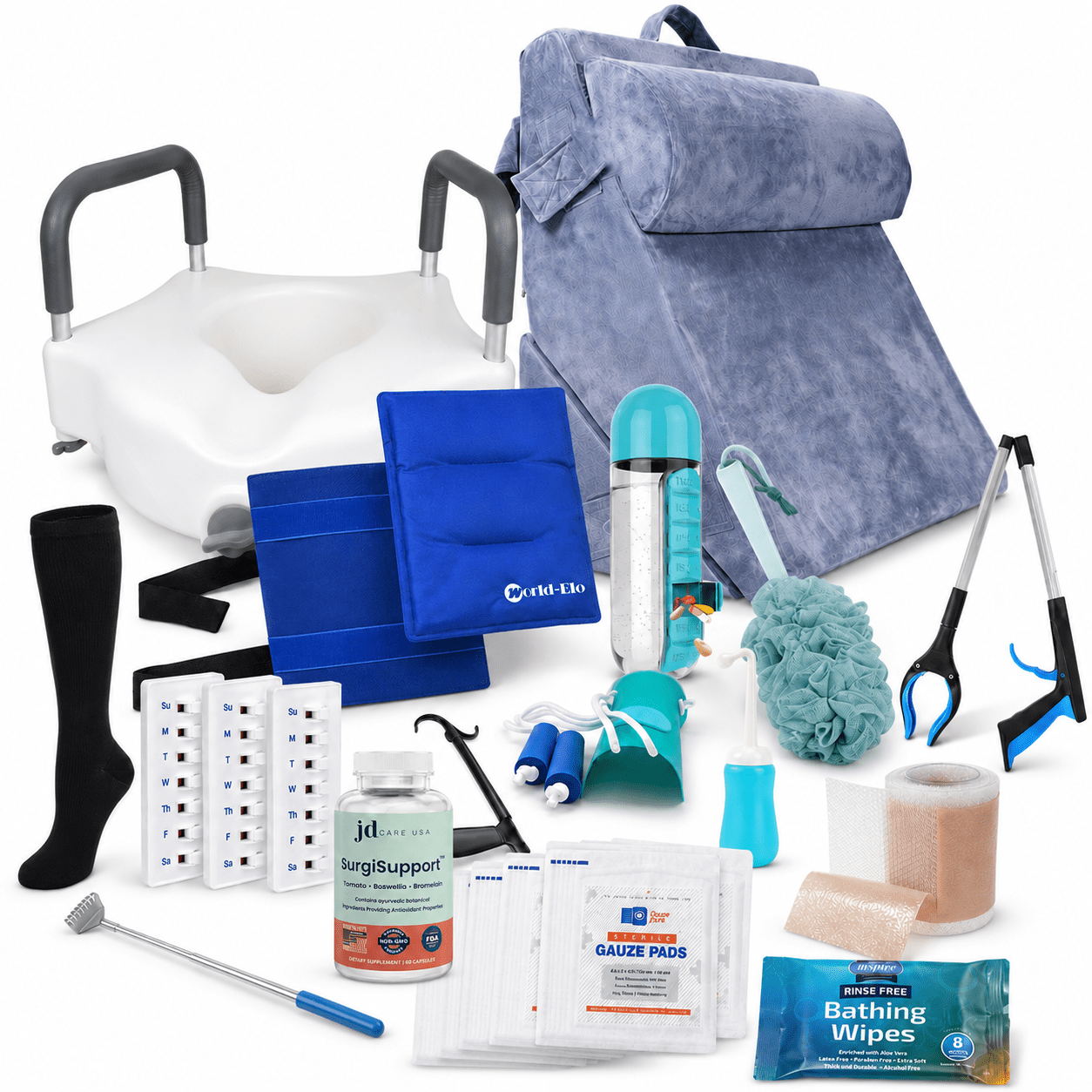
After back surgery, ordinary tasks like sitting up comfortably, using the bathroom, reaching for things, applying cold therapy, and keeping medications organized can suddenly take real planning. The Back Surgery Recovery Kit (23 pc) brings many of those recovery essentials together in one ready-to-use kit.
It's built around elevated comfort, cold therapy, bathroom support, and reduced bending and reaching, including an adjustable wedge pillow, a large ice pack with straps, a raised toilet seat with handles, a folding grabber tool, a dressing hook with shoe horn, a sock aid, medication trackers, and a SurgiSupport™ wellness supplement.5
- Supports elevated, comfortable positioning for resting and sitting up in bed.
- Helps reduce bending, twisting, and reaching during the early recovery window.
- Makes a practical, ready-to-ship care package for someone preparing for back surgery.
Recovery Timeline From Weeks To Months
Because "back surgery" spans such a wide range of procedures, treat any general timeline as a guide rather than a promise. Your surgeon's specific instructions for your procedure always take priority over general recovery timelines like this one.
Warning Signs And When To Call Your Surgeon
Some discomfort is a normal part of healing. Other symptoms need prompt attention. Contact your surgeon if you notice fever, increasing redness or warmth around the incision, drainage, or pain that suddenly gets worse instead of gradually improving.4
Sudden or noticeably different numbness, tingling, or weakness in your legs or feet — or any new difficulty controlling bladder or bowel function — should be treated as urgent and reported right away, since these can point to pressure on the spinal cord or nerves.1
Also watch for signs that can point to a blood clot: swelling, tenderness, or redness in one calf or leg, or sudden chest pain and shortness of breath, which can signal a clot that has traveled to the lungs. These need immediate medical attention — call 911 for chest pain or breathing trouble rather than waiting to see if it passes.3
When in doubt, call your surgeon's office. A short phone call is a much smaller inconvenience than an untreated complication.
Conclusion
Back surgery recovery rarely moves in a straight line, but it's usually predictable once you understand the pattern: protect the healing spine, respect your specific activity restrictions, keep up with physical therapy when it starts, and speak up early about anything that feels like a warning sign rather than ordinary soreness. The goal isn't to rush back to normal — it's to heal in a way that actually holds up once you get there.
Back Surgery Recovery FAQs
How long does back surgery recovery take?
It depends heavily on the procedure. A minimally invasive laminectomy or discectomy may allow a full recovery within about four to six weeks, while a spinal fusion can take several months for the bone to fully solidify, even though comfort often improves much sooner.2
When can I bend, lift, or twist again after back surgery?
Most patients are told to avoid bending, twisting, and lifting for a period after surgery while the spine heals, with the exact restrictions and timeline set by their surgeon based on the specific procedure performed.2
When does physical therapy start after back surgery?
Timing varies by procedure. Some patients begin gentle rehab within weeks of a decompression surgery, while physical therapy after a spinal fusion more commonly starts between six weeks and three months post-surgery, once the surgeon confirms it's appropriate.3
What symptoms after back surgery need urgent medical attention?
Sudden or noticeably worse numbness, tingling, or weakness in the legs or feet, new bladder or bowel changes, signs of infection at the incision, and symptoms of a possible blood clot (calf swelling, chest pain, or shortness of breath) all warrant prompt medical attention.13
What can help make the first weeks of back surgery recovery easier at home?
Practical comfort aids make a real difference for many patients — a supportive wedge pillow for elevated resting, cold therapy for swelling, a raised toilet seat, and reaching tools that reduce bending all help you stay within your activity restrictions while keeping up with daily routines.