
Mastectomy Recovery Kits
Sort by

Breast Surgery Recovery Care
JDCare mastectomy kits include drain support, scar care, and comfort supplies. Everything you need for a safe, supported recovery.
Mastectomy Recovery: What to expect
Mastectomy recovery isn't a straight line. It's a series of small steps, some expected, some surprising, as your body heals and your life resets. In the first days, you're managing pain, drains, and sleep. Weeks later, you're rebuilding strength, learning what movements feel safe, and figuring out what clothes, bras, or prostheses work for you. This guide walks you through what typically happens after surgery, how to care for incisions and drains, ways to protect your arm and shoulder, and how to protect your emotional well-being. You'll see practical tips grounded in current post-operative standards and what many people wish they'd known sooner. Use it alongside your surgeon's instructions: if they conflict, your team's guidance always wins.
What To Expect Immediately After Surgery
You'll wake up in the recovery area with monitors on, a surgical dressing over your chest, and, if placed, one or more drains exiting through small incisions connected to soft bulbs (often called JP drains). A nurse will manage your pain, check your vitals, and ensure you're breathing comfortably.
What you may feel and notice:
- Chest tightness or pressure rather than sharp pain. Numbness over parts of the chest and underarm is common.
- Limited arm movement on the surgery side(s), especially if lymph nodes were sampled or removed.
- A dry mouth, sore throat, or mild nausea from anesthesia that improves over hours.
- A compression wrap or surgical bra if your surgeon uses one.
Hospital stay varies. After a simple mastectomy without reconstruction, you may go home the same day or the next morning. With immediate reconstruction, especially flap procedures, you'll usually stay several days for monitoring.
Before discharge, your team should review:
- Drain care: emptying, measuring output, and how to secure bulbs.
- Medications: pain plan, stool softeners, any antibiotics if prescribed.
- Activity limits: lifting, arm movements, and walking schedule.
- Red flags: what to watch for at home and whom to call.
Have a ride home and help available the first few days. Set up a "recovery nest" with pillows, a wedge for comfortable back-sleeping, easy access to medications and water, and a notebook to track drain outputs and doses.
JDCare Mastectomy Recovery Kits Make Home Care Easy
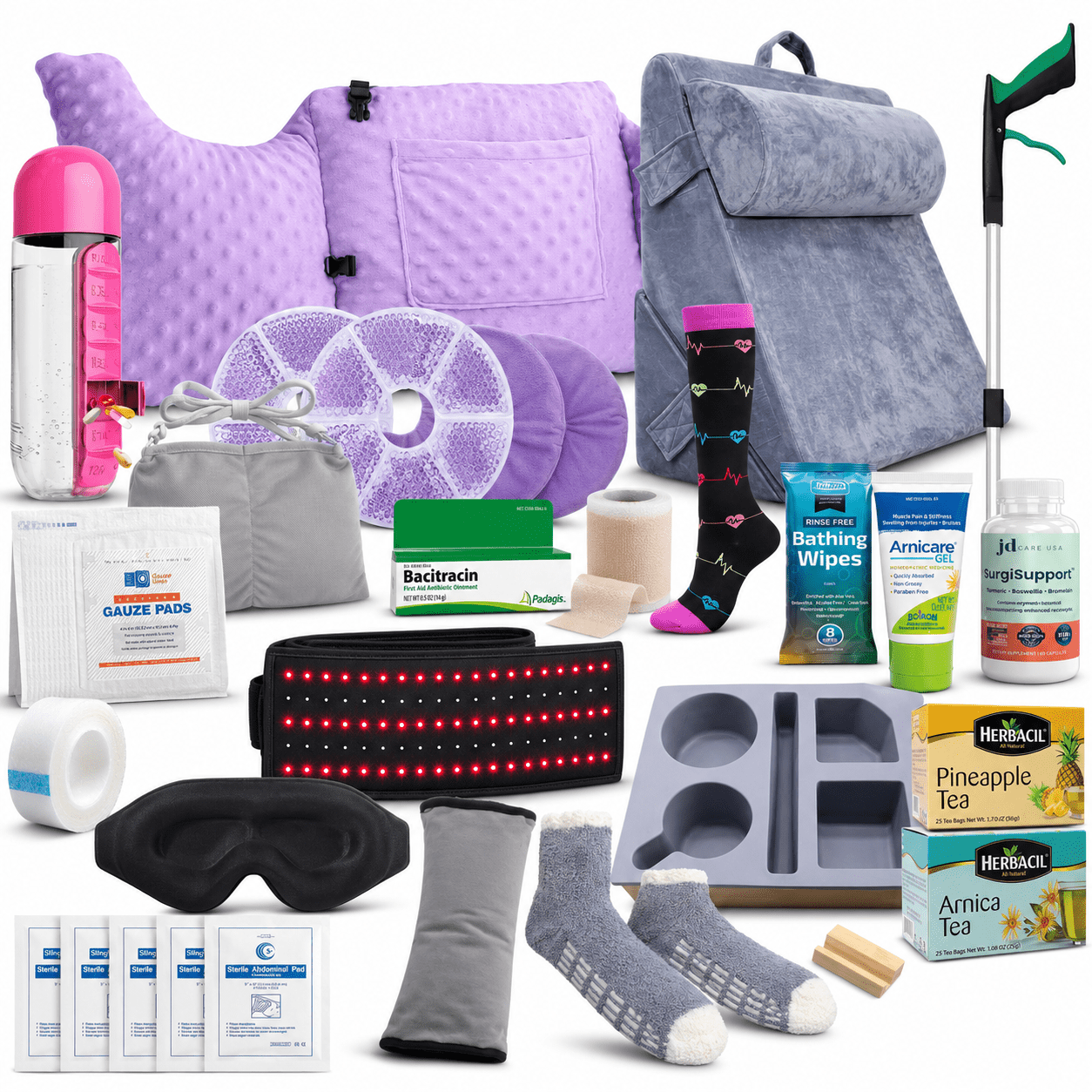
JD Care also offers ready-to-go recovery kits so you don’t have to piece everything together on your own. The Mastectomy Plus Kit (29-piece) brings together the essentials most surgeons and nurses recommend after breast surgery, including drain support for walking and showering, a seatbelt pillow for car rides, underpads for bed and chair, gentle cleansing wipes, and small comfort items that make everyday movements easier.
For even more support, the Ultimate Mastectomy & Breast Augmentation Recovery Kit adds upgraded comforts like an adjustable wedge pillow for elevated sleeping, multiple hot/cold breast packs, a recovery bed tray, grabber tool, and natural recovery aids such as arnica and pineapple tea. Both sets are curated to save time, reduce stress, and help you or your loved one feel more prepared, supported, and comfortable at home after surgery.
Incision, Drain, And Scar Care At Home
Incision care
- Keep dressings clean and dry. Some surgeons use surgical glue or steri-strips that stay on until they curl and fall off. Don't pick at them.
- Unless told otherwise, you can usually remove the outer dressing within 24–48 hours. Follow your specific instructions.
- Check the incision daily for increasing redness, warmth, swelling, pus-like drainage, or a foul smell. A small amount of clear or slightly blood-tinged drainage early on can be normal.
Drain care
- Empty drains at least twice daily or when bulbs are half full, recording the amount and color. Early output is often dark red and becomes lighter and more straw-colored.
- Keep gentle suction by squeezing the bulb flat before replacing the cap.
- Secure the bulbs (safety pin to clothing or a drain belt) to avoid tugging.
- "Stripping" or milking the tubing to prevent clogs should only be done if your team taught you how.
- Drains are typically removed when output is low, often around 20–30 mL per drain in 24 hours for two consecutive days, but your surgeon's threshold may differ.
Showering and wound protection
- Many surgeons allow showering after 24–48 hours: others prefer you wait longer, especially with drains or reconstruction. Let water run gently: avoid direct spray on the incision. Pat dry, don't rub.
- No soaking in baths, hot tubs, or pools until cleared (usually after the incision is fully sealed).
Scar care and healing
- It's normal for scars to look raised, pink, and firm for several weeks. As healing progresses, they flatten and lighten.
- Once the incision is completely closed and your surgeon says it's okay (often after 3–4 weeks), you can begin scar massage and silicone therapy (sheets or gel). These can help soften and minimize scar thickness.
- Protect scars from sun for a year. UV can darken healing tissue.
When to call
- Fever over 100.4°F (38°C) or chills.
- Rapidly expanding redness, increasing warmth, or spreading streaks.
- Thick, foul, or suddenly increasing drainage: bulb no longer staying compressed.
- Significant swelling under the skin (possible seroma), a tense bruise (possible hematoma), or severe pain not controlled by medications.
Pain, Sleep, And Energy Management
Pain control
A multimodal plan keeps you comfortable while minimizing side effects. Your team may recommend acetaminophen and an NSAID (like ibuprofen) on a schedule, with a short course of an opioid if needed for breakthrough pain. Follow your surgeon's directions, some reconstructions or bleeding risks limit NSAIDs. Use stool softeners if you take opioids, drink plenty of fluids, and add fiber to prevent constipation.
Nerve-related sensations, burning, zings, or itching, are common as nerves wake up. Gentle compression garments (if advised), heat or cold packs (only if approved, never directly on skin), and gradual movement help. If pain feels electric, severe, or lingers, ask about nerve-targeted medications or a referral to pain management.
Sleep
- Back-sleeping with a wedge pillow or a recliner can reduce pressure on the chest. Side sleeping is usually possible after the first week or two with pillows supporting your arm and chest, ask your surgeon.
- Short naps help, but try to anchor nighttime sleep with consistent alarms and daytime light exposure.
- Avoid alcohol early on: it can worsen sleep quality and interact with medications.
Fatigue and pacing
Post-operative fatigue is real, even if you "only" had a one-side surgery. Anesthesia, inflammation, stress, and reduced intake all contribute. Aim for:
- Short, frequent walks starting day 1–2, increasing distance daily.
- Protein-rich foods, fruits/vegetables, and hydration. If appetite is low, try small snacks every 2–3 hours and consider a protein shake.
- Gentle breath work to expand your lungs and reduce stiffness.
Use the 10% rule: increase activity by about 10% every few days, not all at once. If you overdo it, pull back a day or two.
You may also be interested in:
- Lumpectomy vs. Mastectomy: How To Choose
- Mastectomy Pillow: What It Is, Types, and How to Choose and Use One
- Mastectomy Bras: Choosing Comfort, Confidence, And Fit After Surgery
- Double Mastectomy: What It Is, Who It’s For, And What To Expect
Safe Movement, Exercises, And Lymphedema Prevention
Your shoulder and chest need motion to heal well, but timing matters. Always follow your surgeon's protocol, which may vary with reconstruction.
Early movement (Days 1–7)
- Frequent short walks for circulation and lung health.
- Gentle hand, wrist, and elbow bends. Shoulder shrugs and scapular squeezes to keep upper-back muscles active.
- Pendulum swings: lean forward supporting yourself with the non-operative arm and let the operative arm dangle, making small circles, this can ease stiffness without strain.
Progressive shoulder range (Weeks 1–3)
- Wall walks: face a wall and "walk" your fingers up as high as comfortable, then down. Stop if you feel sharp pulling at the incision.
- Wand or broomstick exercises for assisted flexion and abduction if cleared.
- Goal (typical): regain overhead reach by 2–4 weeks without force. If you had immediate reconstruction, your team may limit ranges initially.
Strength and posture (Weeks 3–6+)
- Light resistance work only after your surgeon says it's okay. Start with isometrics and very light bands.
- Daily posture checks: tall chest, relaxed shoulders, gentle chin tuck. Prolonged "guarding" can cause neck/upper-back pain.
Lymphedema basics
Your risk increases if lymph nodes were removed or radiated. Prevention focuses on protecting the arm and promoting lymph flow:
- Avoid blood pressure cuffs, heavy lifting, and needle sticks on the affected arm when possible. If unavoidable, communicate your history so the team takes precautions.
- Keep skin moisturized and protect against cuts and burns (including cooking and gardening). Promptly clean and monitor any breaks in the skin.
- Maintain a healthy body weight and keep moving: muscle contractions assist lymph return.
- Watch for swelling, a feeling of heaviness or tightness, jewelry feeling snug, or pitting skin. Early evaluation matters.
- Ask for a referral to a lymphedema therapist (certified CLT). They can teach self-massage (manual lymph drainage), proper compression use, and safe progression of exercise.
If you notice underarm "cords" pulling down the arm (axillary web syndrome), gentle stretching under guidance from a physical therapist often helps and usually resolves over weeks.
Daily Living: Showering, Clothing, Bras, Prostheses, Driving, And Work
Showering and hygiene
- Use a handheld shower or stand with your back to the spray: let water run over incisions without scrubbing. A lanyard or drain belt keeps bulbs from dangling.
- Pat dry with a clean towel: a cool blow-dryer on low can help around incisions.
Clothing
- Button-front or zip-front tops are your friends. Loose sleeves and soft fabrics reduce friction.
- Choose pants/shorts that are easy to pull on without heavy bending.
Bras and compression
- Immediately after surgery, you may be given a surgical bra or wrap. Wear it as instructed.
- If you need a replacement: look for front-closure, wireless, soft, wide straps, and a longer band to avoid rubbing the incision. Avoid underwire until fully healed.
- If your team recommends compression, stick to the specific level and duration. Too-tight garments can impair healing.
Prostheses
- In the first weeks, a soft "puff" or fiberfill form in a pocketed bra can balance clothing without adding weight.
- A weighted silicone prosthesis is usually fitted after complete healing (often 6–8 weeks or later). Insurance often covers fittings, ask for a prescription and a certified fitter.
Driving
- Don't drive while on opioid pain meds or if you can't turn the wheel quickly and safely. Most people resume driving in 1–2 weeks after a simple mastectomy and longer with reconstruction. First test your range of motion and ability to brake hard in a parked car.
Work and household tasks
- Desk work: many return in 2–3 weeks: physical jobs can require 4–8+ weeks or a graduated return, especially after reconstruction.
- Lifting limits are common (often no more than 5–10 lbs initially). Ask for help with pets, laundry, and groceries. Use rolling carts: avoid vacuuming early on.
Listen to fatigue: one "normal" day can set you back if you load it with errands. Build up slowly.
Reconstruction Choices And Flat Closure: Impact On Recovery
Your mastectomy recovery timeline depends heavily on whether you chose reconstruction and which type.
Flat closure (aesthetic flat closure)
- Recovery is often shorter than with reconstruction, though you'll still manage drains and chest tightness.
- Key issues: scar comfort, posture, and chest wall mobility. Once healed, scar massage and targeted stretching help prevent tethering. If you notice extra skin at the sides ("dog ears"), revision can be discussed later.
Implant-based reconstruction
- Usually involves a tissue expander placed under or over the pectoral muscle, later exchanged for a permanent implant. You may feel pressure from expansions over weeks.
- Expect more chest tightness: some surgeons limit early arm elevation. Follow their range-of-motion plan closely.
- Risks include infection, seroma, capsular contracture, and implant loss, report concerning signs early.
Autologous flap reconstruction (DIEP, TRAM, latissimus, etc.)
- Uses your tissue to create a breast mound. Hospital stays are longer (often 3–5 days). You'll have more drains and additional incision sites (abdomen, back, or thigh) to protect.
- Abdominal flaps add core precautions: no heavy lifting, bracing with a pillow to cough, and careful posture to protect the donor site. Walking slightly bent at first is common.
Radiation and timing
- If you'll need radiation, some surgeons recommend delaying final reconstruction or using a temporary expander. Radiation can affect skin elasticity and healing: your team will tailor the plan.
Whichever path you chose, reconstruction or going flat, your goals are comfort, symmetry in clothing if you want it, and function. Advocate for physical therapy if motion stalls or pain persists.
Medical Follow-Up: Pathology Results, Appointments, And When To Call
Pathology results and next steps
Surgical pathology typically returns in about 7–14 days. It details tumor size, margins, lymph node status, and receptor profile (ER/PR/HER2 if relevant). These results guide adjuvant treatment such as endocrine therapy, chemotherapy, targeted therapy, and/or radiation.
Your surgeon or oncologist will discuss:
- Whether margins are clear or if re-excision is needed.
- Lymph node findings and lymphedema risk.
- Timelines for starting additional treatment and how that affects healing.
Routine post-op visits
- Early visits focus on drain removal, incision checks, and pain control.
- Later visits assess range of motion, scar progress, and readiness for expansions or therapy referrals.
Call urgently or seek care if you have:
- Fever >100.4°F (38°C), worsening redness, or foul drainage.
- Sudden, significant swelling or a rapidly expanding bruise.
- Chest pain, shortness of breath, new calf pain/swelling (possible blood clot or PE, emergency).
- Uncontrolled pain, new asymmetric arm swelling, or severe limitation of motion.
Keep a running list of questions. Bring a support person to appointments, they can take notes while you focus on the conversation.
Emotional Health, Body Image, And Intimacy
Physical healing and emotional processing don't move at the same speed. You might feel relief, grief, anger, or all three in a single day. Give yourself permission to feel what you feel, and ask for help early.
Emotional health
- Short, structured check-ins with yourself work: "What's one thing that's hard today? One thing that helped?"
- Consider counseling with a therapist experienced in cancer care. Many centers offer oncology social workers or psycho-oncology services.
- Peer support, local groups or reputable online communities, can normalize what you're experiencing and offer practical tips that only someone who's been there knows.
Body image
- It's okay if you're not ready to look at your chest immediately. When you are, do it in a supportive setting with someone you trust if that helps.
- Clothing, scarves, camisoles, and prostheses can be tools, not obligations. Use them if they make you more comfortable.
- Over time, scar care, posture work, and purposeful movement often improve how your body feels from the inside out.
Intimacy
- Numbness and altered sensation are common. Some people find new erogenous zones with time and exploration.
- Talk with your partner about comfort, pacing, and preferences. Agree on non-sexual touch while you heal.
- If you're on endocrine therapy, vaginal dryness is common: ask about moisturizers and lubricants. A sexual health specialist can tailor options that are safe with your treatment.
If persistent sadness, anxiety, or sleep problems interfere with daily life, tell your team. Depression and PTSD are treatable, and you don't have to white-knuckle it alone.
Other Recovery Kits:
Surgery Recovery
Tummy Tuck Recovery
BBL Recovery
Liposuction Recovery
Conclusion
Mastectomy recovery is a process, not a deadline. In the first days, you focus on wound and drain care, pain control, and protecting your energy. In the following weeks, you restore shoulder motion, prevent lymphedema, and return, step by step, to driving, work, and the activities that make you feel like yourself. Your exact timeline depends on whether you had reconstruction or a flat closure, whether nodes were removed, and whether additional treatment is planned.
Keep the essentials close: follow your surgeon's instructions, move a little every day, fuel your body, and speak up early if something doesn't look or feel right. And remember, your recovery isn't just physical. Make space for emotions, bring trusted people into the process, and use resources, from physical therapy to support groups, that keep you supported while you heal. You're doing hard, important work, and it counts every single day.
Mastectomy Recovery: Frequently Asked Questions
What is the typical mastectomy recovery timeline?
Mastectomy recovery varies by procedure. After a simple mastectomy, many go home same day or next day; overhead reach often returns in 2–4 weeks. Driving typically resumes in 1–2 weeks (longer with reconstruction). Desk work often 2–3 weeks; physical jobs 4–8+ weeks. Always follow your surgeon’s specific plan.
How do I care for surgical drains after a mastectomy, and when are they removed?
Empty drains at least twice daily or when half full, keep suction by compressing the bulb, and log output and color. Secure bulbs to avoid tugging. Many surgeons remove drains when output is about 20–30 mL per 24 hours for two consecutive days. Call if redness, foul drainage, or sudden swelling occurs.
What exercises are safe early in mastectomy recovery to prevent stiffness and lymphedema?
Start with short walks, hand/wrist/elbow motions, shoulder shrugs, and gentle pendulums in days 1–7. Progress to wall walks and assisted stick exercises in weeks 1–3 if cleared. Avoid heavy lifting early on. If lymph nodes were removed, ask for a certified lymphedema therapist to guide safe progression and compression use.
When can I drive and return to work after a mastectomy?
Don’t drive on opioid pain medication, and only when you can turn the wheel and brake hard safely. Many resume driving in 1–2 weeks after a simple mastectomy, longer with reconstruction. Desk work often resumes in 2–3 weeks; physically demanding roles may need 4–8+ weeks or a phased return.
What should I eat to support mastectomy recovery and reduce fatigue?
Aim for protein-rich meals and snacks, colorful fruits and vegetables, whole grains, and adequate fluids. Small, frequent meals can help when appetite is low. Include fiber to prevent constipation, especially if using opioids. Discuss supplements with your care team; prioritize balanced nutrition and hydration for steady energy.
How long do numbness and nerve zings last after mastectomy, and what helps?
Numbness and tingling often improve over weeks to months but can persist longer in some areas. Gentle movement, approved compression, and desensitization massage may help. If pain feels electric or lingers, ask about nerve-targeted medications, physical therapy, or pain management. Report new, severe, or worsening symptoms promptly.
References
American Cancer Society, 2021. Exercising after breast cancer surgery. American Cancer Society.
American Cancer Society, 2025. What is a mastectomy? American Cancer Society.
Anderson, R.T., Kimmick, G.G., McCoy, T.P., Hopkins, J., Levine, E., Miller, G., Ribisl, P. & Mihalko, S.L., 2012. A randomized trial of exercise on well-being and function following breast cancer surgery: The RESTORE trial. Journal of Cancer Survivorship, 6(2), pp.172–181.
Breastcancer.org, 2025. Mastectomy surgery & recovery: what to expect. Breastcancer.org.
Burstein, H.J. & Winer, E.P., 2000. Primary care for survivors of breast cancer. New England Journal of Medicine, 343(15), pp.1086–1094.
Campbell, K.L., Winters-Stone, K.M., Wiskemann, J., May, A.M., Schwartz, A.L., Courneya, K.S., Zucker, D.S., Matthews, C.E., Ligibel, J.A., Gerber, L.H., Morris, G.S., Patel, A.V., Hue, T.F., Perna, F.M. & Schmitz, K.H., 2019. Exercise guidelines for cancer survivors: consensus statement from international multidisciplinary roundtable. Medicine & Science in Sports & Exercise, 51(11), pp.2375–2390.
Cancer Research UK, n.d. Exercises after a mastectomy or breast-conserving surgery (lumpectomy). Cancer Research UK.
Cleveland Clinic, 2025. Mastectomy: what it is, surgery details & recovery. Cleveland Clinic.
DiSipio, T., Rye, S., Newman, B. & Hayes, S., 2013. Incidence of unilateral arm lymphoedema after breast cancer: a systematic review and meta-analysis. The Lancet Oncology, 14(6), pp.500–515.
Ferreira, R., Jeronimo, C., Mira, A., Pereira, A., Serrano, S., Marques, M.F., Baixinho, C.L., Fonseca, C. & Sousa, L., 2025. The rehabilitation of women who have had a mastectomy. Nursing Reports, 15(4), p.133.
Ganz, P.A., Rowland, J.H., Desmond, K., Meyerowitz, B.E. & Wyatt, G.E., 1998. Life after breast cancer: understanding women’s health-related quality of life and sexual functioning. Journal of Clinical Oncology, 16(2), pp.501–514.
He, L., Qu, H., Wu, Q. & Song, Y., 2020. Lymphedema in survivors of breast cancer. Oncology Letters, 19(3), pp.2085–2096.
MD Anderson Cancer Center, 2024. Mastectomy recovery: what to expect after breast removal surgery. MD Anderson Cancer Center.
Memorial Sloan Kettering Cancer Center, 2023. Exercises after your mastectomy or breast reconstruction. Memorial Sloan Kettering Cancer Center.
Min, J., Kim, J.Y., Ryu, J., Park, S., Courneya, K.S., Ligibel, J., Kim, S.I. & Jeon, J.Y., 2024. Early implementation of exercise to facilitate recovery after breast cancer surgery: a randomized clinical trial. JAMA Surgery, 159(8), pp.872–880.
National Comprehensive Cancer Network (NCCN), 2020. NCCN Guidelines for Patients: Survivorship – Care for cancer-related late and long-term effects. NCCN.


