
BBL Recovery Kits
Sort by
Post-Op Comfort Essentials
Discover BBL recovery kits designed for comfort and support. Includes foams, pillows, hygiene supplies, and care items for smoother recovery.
BBL Recovery: Timeline, Tips, And What To Expect
A Brazilian Butt Lift (BBL) is more than a surgery day, it's a weeks-long partnership between you, your body, and your surgeon's plan. The way you manage your BBL recovery will influence how much fat survives, how your shape settles, and how quickly you get back to normal life. Below, you'll find a clear timeline, practical strategies for sitting and sleeping, nutrition guidance, and the red flags you should never ignore. Use this as your roadmap, and personalize it with your surgeon's instructions, those always win.
BBL Recovery Kit to Simplify Your Healing Process
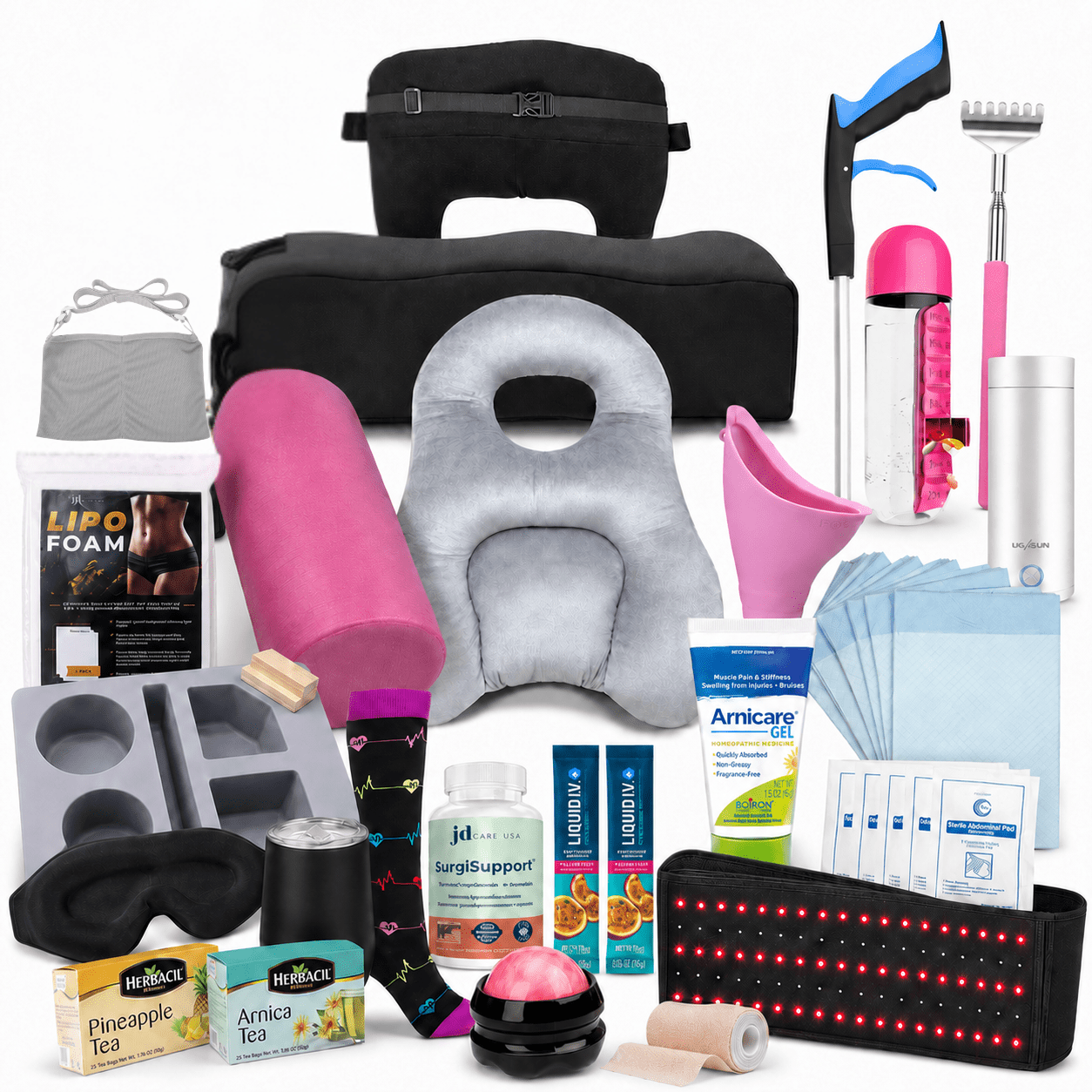
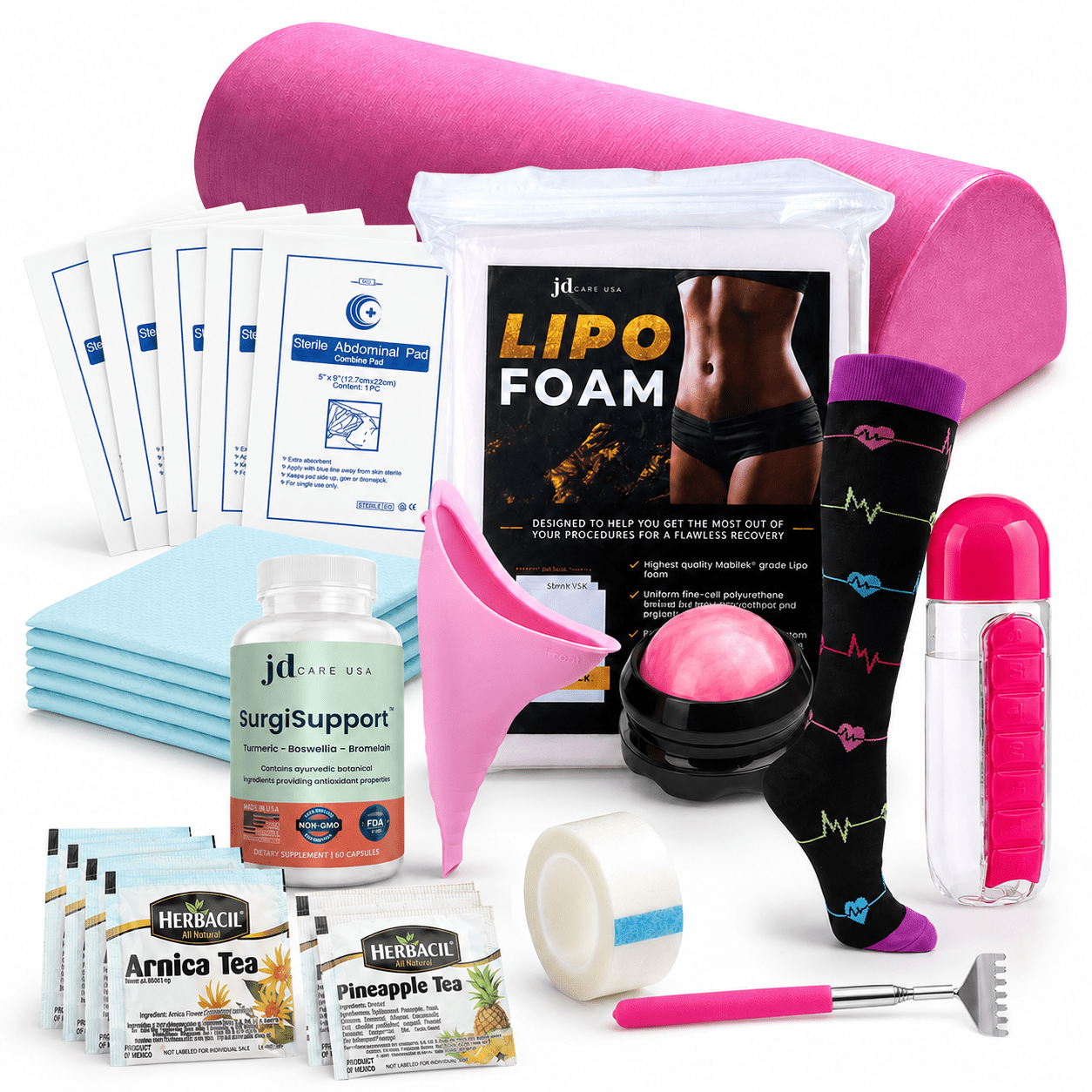
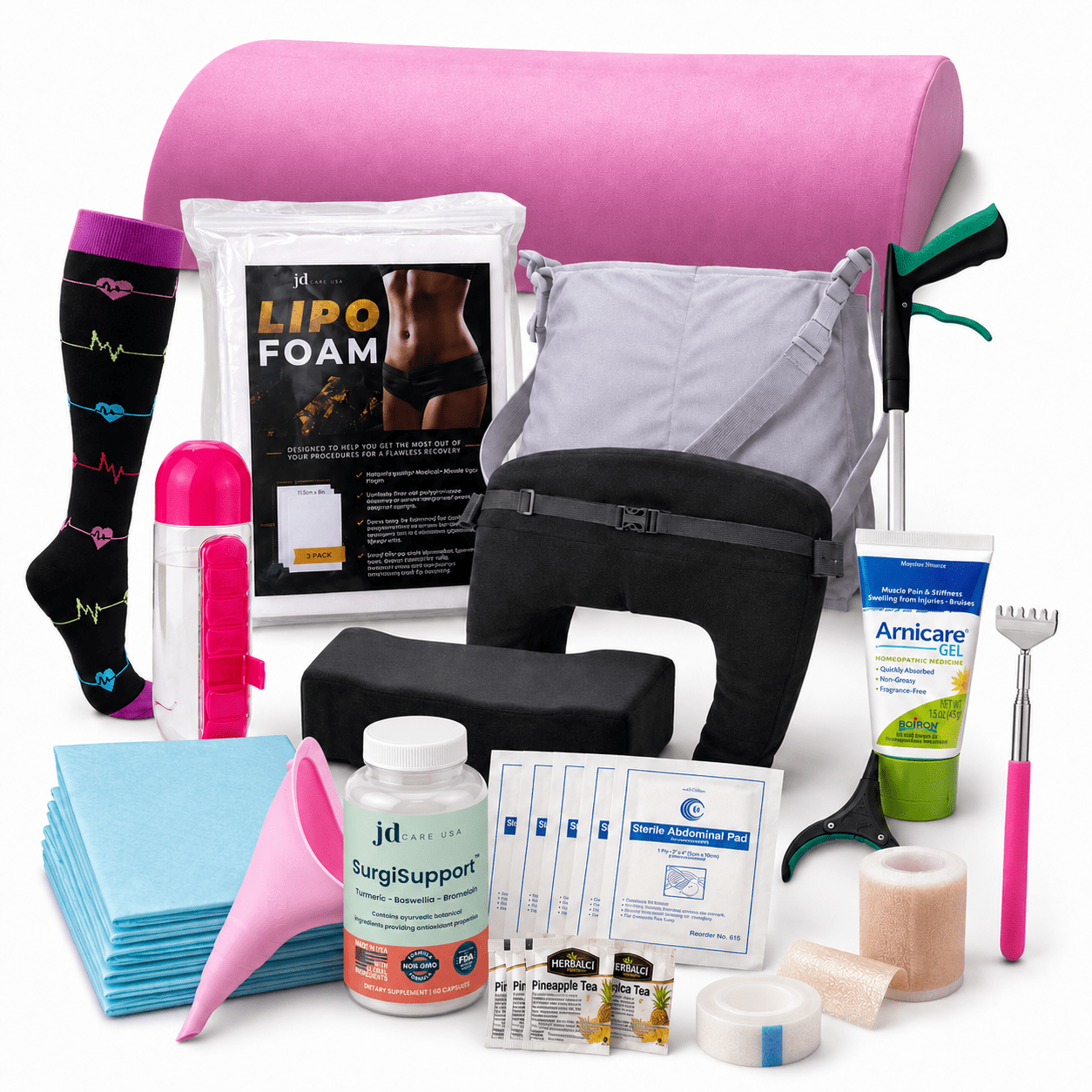
JD Care also offers curated BBL surgery recovery kits so you don’t have to guess what you’ll need after a Brazilian Butt Lift. Each kit is built around the real-life challenges of BBL recovery: you’ll find a dedicated BBL pillow and backrest to keep pressure off your buttocks, absorbent underpads to protect your bedding, lipo foam and ABD pads for compression, a female urinal to make bathroom trips easier when sitting is limited, and practical extras like pill organizers, scar gel and gentle cleansing wipes. The Plus and Ultimate BBL kits layer in even more comfort and convenience with upgraded pillows, mobility and hygiene essentials, and thoughtful small items that help you stay clean, supported and as comfortable as possible while you heal at home.
What BBL Recovery Involves
How Fat Grafts Heal And Stabilize
A BBL transfers your own purified fat from liposuctioned areas into the buttocks. Once injected, those fat cells behave like transplants. In the first 72 hours, the grafted cells rely on diffusion for oxygen and nutrients. By roughly day 3–7, tiny new blood vessels begin to connect to the grafts (revascularization). Over weeks, the surviving fat cells integrate and stabilize. Not all cells make it. A realistic "take rate" often lands around 60–80% depending on technique, your biology, and how well you protect the area from pressure.
This is why your early choices, no direct sitting, steady compression around lipo'd areas (not crushing the grafts), steady hydration, and avoiding nicotine, are not optional. They're the difference between a short-term volume bump and a lasting contour change.
Typical Discomfort, Swelling, And Bruising
Expect more soreness where liposuction was done than in the buttocks. Swelling peaks in the first week, then gradually recedes over 3–6 weeks. Bruising can migrate with gravity (you may see it drift downward). Tightness, lumpy firmness, and asymmetry are common early and usually settle as swelling resolves and scar tissue softens. Numb patches around lipo sites can take weeks or months to normalize.
You shouldn't feel sharp, worsening pain, hot/firm redness, or notice sudden size changes on one side, those warrant a check-in.
What Results To Expect And When
- Weeks 1–2: You'll look bigger due to swelling. Don't judge your outcome yet.
- Weeks 3–6: Swelling decreases: some volume loss occurs as non-surviving fat is resorbed.
- Months 3–6: Shape and projection stabilize as grafts mature and tissues soften. This is when "final-ish" results appear.
Long-term, grafted fat behaves like regular fat. If you gain weight, the area can enlarge: if you lose weight, it can shrink. Aim for weight stability for the most predictable result.
Prepping For A Smooth Recovery
Home Setup And Essential Supplies
Prepare your space before surgery so you can focus on healing:
- BBL cushion and a wedge/backrest to offload pressure when sitting.
- Extra pillows to support side or stomach sleeping.
- Compression garments (primary + backup) in the surgeon-recommended size.
- Loose, front-opening clothes: slip-on shoes.
- Waterproof bed protector and dark towels.
- Thermometer, pill organizer, and a notepad (track meds, fluids, bathroom trips).
- Gentle soap, sterile gauze, and surgeon-approved ointments for incision care.
- High-protein snacks, electrolyte packets, a large water bottle, and fiber options.
Stage your bathroom and bedside with everything within arm's reach. Small detail, big payoff.
Planning Time Off And A Support System
You'll need a ride home and an adult with you the first 24 hours. Many patients take 1–2 weeks off from desk work: manual labor or childcare may require longer. Line up help for pets, kids, meals, and rides to follow-ups. Put your surgeon's office and after-hours number in your phone and on the fridge. If you'll be alone after day 1, consider brief daily check-ins with a friend or a postoperative nursing service.
The Recovery Timeline
Day 0–3: Immediate Post-Op Priorities
- Positioning: No direct pressure on your buttocks. Lie on your stomach or side with pillows stabilizing your hips and knees.
- Movement: Short, frequent walks every 1–2 hours while awake to reduce clot risk.
- Medications: Take pain meds and antibiotics exactly as prescribed. Start stool softeners with the first narcotic dose.
- Hydration and protein: Sip fluids steadily: aim to eat small, protein-rich meals.
- Compression: Wear your garment continuously (except brief hygiene breaks) as instructed. Do not compress the grafted areas themselves.
- Watchpoints: Excessive bleeding, shortness of breath, uncontrolled pain, or a hot, rapidly enlarging area, call your surgeon or seek urgent care.
Days 4–7: Early Healing And Mobility
- Swelling likely peaks, then starts easing. Bruising can look worse before it looks better.
- Keep walking more frequently and gently stretch calves, hips, and back.
- You can use a BBL cushion for essential, brief sitting, hip-thigh weight bearing only, avoiding buttock pressure.
- Many surgeons allow a cautious switch from narcotics to acetaminophen or COX-2–selective meds (if approved). Avoid traditional NSAIDs unless your surgeon clears them.
- First lymphatic drainage session may be recommended for lipo areas, only if your surgeon supports it and never over grafts.
Weeks 2–3: Transition Phase And Reduced Swelling
- Energy returns: swelling starts to visibly drop in lipo zones.
- Some volume loss in the buttocks is normal as non-viable fat is absorbed.
- You may be cleared for slightly longer sitting with a cushion (15–30-minute blocks) and light household tasks.
- If incisions are closed and dry, you can typically shower freely: soaking still waits.
Weeks 4–6: Gradual Return To Normal Activities
- You may begin longer sits with a cushion, but still limit total pressure time and shift positions often.
- Light cardio and bodyweight exercises (no glute-focused loading) are commonly cleared around week 4–6, per your surgeon.
- Many return to desk work at 2 weeks: others at 3–4. Heavier jobs may need 4–6+ weeks.
- Incisions often transition to scar care: silicone gel/sheets and sun protection.
Months 3–6: Final Contouring And Stabilization
- The grafts stabilize. What you see around month 3–6 is close to your long-term baseline.
- You can usually resume progressive lower-body training, including glutes, if fully cleared.
- Scars continue to remodel for up to a year: keep using sunscreen and silicone per guidance.
- This is also when you and your surgeon can fairly evaluate whether touch-ups are warranted.
Protecting Your Results: Sitting, Sleeping, And Compression
No-Pressure Sitting Strategies And BBL Cushions
Direct buttock pressure can jeopardize fat survival during the first 2–4 weeks. A BBL cushion shifts your weight to the thighs, keeping grafts offloaded. Use it for short, essential sits only: set a timer for 15–30 minutes, then stand or lie down. For work, consider a kneeling chair or standing desk. Driving combines sitting with vibration, delay until you're off narcotics, can brake safely, and your surgeon approves limited, cushioned drives.
Side Or Stomach Sleeping Positions
Sleep on your stomach or on your side with pillows between the knees and behind the back to prevent rolling. Alternate sides nightly to avoid creating pressure points. If you're a chronic back sleeper, barricade with pillows or a body wedge. Most surgeons relax strict sleep rules after 2–4 weeks as grafts stabilize, but ease back gradually.
Compression Garment Fit, Schedule, And Care
Compression helps control swelling and smooth lipo areas. Common protocols: 23 hours/day for 3–4 weeks, then 12–16 hours/day up to 6–8 weeks. Your garment should be snug but not painful, with no ripples or bands digging into the buttocks. Many use a Stage 1 (softer) garment for 1–2 weeks, then a Stage 2 (firmer) as swelling subsides. Wash garments frequently to maintain elasticity and skin health. If you see indentations or numbness worsening in a banded pattern, reassess fit with your surgeon.
Activity, Work, And Travel
Walking, Stretching, And Light Exercise
Walking is medicine in BBL recovery. Start day one, short and frequent. Add gentle range-of-motion for hips, knees, and ankles. Around week 2–3, you may layer in light upper-body work and core activation that doesn't compress the buttocks. Save glute loading (squats, hip thrusts, cycling sprints) for the later phase when cleared, loading too soon can alter shape.
Returning To Work, Driving, And Daily Tasks
- Desk work: Often 1–2 weeks with strict cushion use, position changes every 20–30 minutes.
- Manual or on-your-feet jobs: 3–6+ weeks depending on lifting requirements and swelling.
- Driving: Only after you're off narcotics, can sit with a cushion briefly, and can perform an emergency stop safely, commonly after 2–3 weeks.
- Daily tasks: Break chores into small blocks. Use reachers for dropping items, and keep heavy lifting off the calendar early on.
Gym, Swimming, And Air Travel Timelines
- Gym: Light cardio and machines that avoid buttock pressure may resume around weeks 4–6 if you're healing well. Progressive glute training typically restarts around 6–8+ weeks with surgeon clearance.
- Swimming, hot tubs, baths: Only after all incisions are sealed with no scabs, often 3–4+ weeks. Pools and hot tubs carry infection risk if you go too soon.
- Air travel: Short flights may be considered around 3–4 weeks with frequent walking and a cushion: longer flights often wait until 4–6+ weeks depending on your clot risk and surgeon's advice. Hydrate, wear compression stockings, and move every hour.
Pain Control, Medications, And Scar Care
Managing Pain Without Harming Grafts
A typical plan includes a short course of prescription pain meds, then a transition to acetaminophen. Some surgeons use celecoxib (a COX-2 selective NSAID) early: many prefer you avoid traditional NSAIDs like ibuprofen in the first days due to bleeding risk. Always follow your surgeon's specific protocol.
Non-drug strategies help a lot: scheduled walking, gentle breathing, a supportive garment, cool (not icy) compresses on lipo zones, not on the grafted buttocks. Sleep and protein intake also reduce pain perception.
Antibiotics, Laxatives, And Helpful Supplements
- Antibiotics: Take exactly as prescribed and complete the course.
- Bowel regimen: Start stool softeners with narcotics to prevent constipation. Add fiber, magnesium citrate (if approved), and plenty of water.
- Supplements: Evidence varies, but many surgeons allow vitamin C (500–1000 mg/day), zinc for short courses, and bromelain/arnica for bruising, only if cleared, since supplements can interact with meds or affect bleeding. Avoid any supplement your surgeon hasn't approved.
- Absolutely avoid nicotine in all forms for at least 4–6 weeks: it constricts vessels and can starve grafts.
Incision Care, Massage, And Skin Health
Keep incisions clean and dry per instructions. Once closed, you may transition to silicone gel/sheets for 8–12+ weeks to optimize scars, plus sunscreen (SPF 30+). For lipo areas, many surgeons encourage gentle lymphatic drainage to reduce fibrosis, beginning in week 1–2: technique matters, and you should avoid direct pressure over the buttocks where grafts were placed. Moisturize skin as it may feel tight, and don't pick at flaking or scabs. If you notice thick, itchy, raised scars, ask about silicone, steroid injections, or laser options later in recovery.
Nutrition And Lifestyle For Optimal Healing
Protein, Hydration, And Calorie Targets
Your body's rebuilding. Aim for roughly 1.2–1.5 grams of protein per kilogram of body weight per day (about 0.55–0.7 g/lb). If you're 160 lb, that's about 90–110 grams daily. Maintain a slight caloric surplus in the first 2–4 weeks to support fat graft survival and overall healing. Hydration target: 2–3 liters of fluids daily unless you've been told otherwise. Include electrolytes if you're sweating in a garment or flying.
Focus on nutrient-dense foods: eggs, fish, poultry, Greek yogurt, beans, tofu, olive oil, avocado, colorful produce, and whole grains. Keep sodium moderate to help manage swelling.
Avoiding Alcohol, Nicotine, And Pressure
- Alcohol can dehydrate you, increase bleeding risk, and clash with meds. Avoid for at least 1–2 weeks or until off all narcotics and your surgeon says it's okay.
- Nicotine (including vapes, patches, gum) and secondhand smoke impair blood flow. Strictly avoid 4–6+ weeks pre/post.
- Pressure is the enemy of fat survival early on, protect your investment by limiting sits, using your cushion, and following sleep positioning faithfully.
Weight Stability And Long-Term Maintenance
After the grafts stabilize (around 3–6 months), maintain a stable weight to preserve proportions. If you plan significant weight loss, discuss timing before surgery, as losing weight after can shrink both the donor areas and the grafts. Long-term, support your shape with strength training (including glutes once cleared), adequate protein, and consistent hydration. Sunscreen on scars, always.
Risks, Red Flags, And When To Call Your Surgeon
Normal Versus Concerning Symptoms
Normal early signs: moderate swelling, bruising that changes color, mild drainage from lipo sites, tightness, temporary lumps, low-grade temperature up to about 100.4°F in the first 24 hours.
Concerning signs you shouldn't ignore:
- Fever over 101.5°F, chills, or feeling acutely unwell
- Increasing, throbbing pain unrelieved by meds
- Spreading redness, warmth, or foul-smelling drainage
- Sudden, asymmetric swelling or a tense, painful area
- Shortness of breath, chest pain, coughing up blood
- New calf pain or one leg that's swollen and tender
- Severe headache, confusion, or vision changes
Signs Of Infection, Clots, Or Fat Embolism
- Infection: escalating redness, heat, pus-like discharge, persistent fever.
- Deep vein thrombosis (DVT): calf pain, one-sided leg swelling, warmth: risk rises with immobility or long flights.
- Pulmonary or fat embolism: sudden shortness of breath, chest pain, rapid heart rate. This is an emergency, call 911.
You can lower risks by walking frequently, staying hydrated, wearing compression stockings for travel, and following medication plans exactly.
Follow-Ups, Revisions, And When A Second BBL Is Considered
Attend every follow-up, your surgeon can spot issues long before you can. Document your progress with the same lighting and angles every two weeks. If, after 3–6 months, you'd like more projection or notice asymmetry that doesn't settle, a touch-up or second-stage BBL might be discussed. Additional fat availability, skin quality, and safety considerations will guide that decision. Expect any revision talk only after tissues fully settle unless there's an urgent problem.
Conclusion
Your BBL recovery is a series of smart, consistent choices: protect the grafts from pressure, move early and often, fuel your body, and keep a close eye on warning signs. Most of the heavy lifting happens in the first 4–6 weeks, but the real reveal unfolds at 3–6 months. Treat the process with the same seriousness as the procedure, lean on your support system, and stay in close contact with your surgical team. The payoff, long-lasting, natural-looking contours, comes to those who recover with intention.
Read also:
- The Comprehensive Guide to Brazilian Butt Lifts
- BBL And Liposuction: What Are They And Which Do I Go For?
- So You Just Had A BBL: The Importance of BBL Fajas and Aftercare
- The Rise of Brazilian Butt Lifts
- Top Alleged Celebrities Who've Had BBLs
- Does a BBL Have a Smell?
Other Recovery Kits:
Surgery Recovery
Tummy Tuck Recovery
Liposuction Recovery
Mastectomy Recovery
Frequently Asked Questions About BBL Recovery
What is the typical BBL recovery timeline and when do results settle?
Early BBL recovery spans 2–4 weeks, when you must avoid direct buttock pressure. Swelling peaks in week 1 and declines over weeks 3–6 as some non-viable fat is reabsorbed. By months 3–6, grafts stabilize and contours soften—this is your “final-ish” look. Maintain stable weight for predictable results.
How soon can I sit after a BBL and how should I use a BBL cushion?
During BBL recovery, avoid direct buttock pressure for the first 2–4 weeks. Use a BBL cushion to shift weight onto your thighs for brief, essential sitting—15–30 minutes at a time, then stand or lie down. For work, rotate positions frequently, consider a standing desk or kneeling chair, and delay driving until cleared.
What should I eat and drink during BBL recovery to support fat graft survival?
Aim for about 1.2–1.5 g of protein per kg body weight daily, a slight calorie surplus for 2–4 weeks, and 2–3 liters of fluids. Favor nutrient-dense foods—lean proteins, healthy fats, whole grains, and colorful produce. Keep sodium moderate, avoid alcohol early, and strictly avoid nicotine for 4–6+ weeks.
When can I return to work, driving, and exercise after a BBL?
Desk work often resumes at 1–2 weeks with cushion use and frequent breaks; heavier jobs may need 4–6+ weeks. Driving usually waits 2–3 weeks until you’re off narcotics and can brake safely. Light cardio is commonly cleared around weeks 4–6; progressive glute training returns near 6–8+ weeks, pending surgeon approval.
Do I need lymphatic drainage massage after a BBL, and when should I start?
Many surgeons recommend gentle lymphatic drainage for liposuction areas to reduce swelling and fibrosis, starting around week 1–2 if incisions are closed. Technique matters—avoid direct pressure over grafted buttocks. Because protocols vary, follow your surgeon’s plan and choose a therapist experienced in post-lipo care.
What warning signs during BBL recovery mean I should call my surgeon?
Seek prompt care for fever over 101.5°F, chills, worsening or throbbing pain, spreading redness, foul drainage, sudden one-sided swelling, shortness of breath, chest pain, rapid heartbeat, or new calf pain. These may indicate infection, DVT, or embolism. Early walking, hydration, and following medication instructions help lower risks.
References
American Society of Plastic Surgeons (ASPS). 2025. Gluteal fat grafting advisories. American Society of Plastic Surgeons, Arlington Heights, IL, USA.
American Society of Plastic Surgeons (ASPS). n.d. The dangers of improper Brazilian butt lifts. American Society of Plastic Surgeons, Arlington Heights, IL, USA.
American Society of Plastic Surgeons (ASPS). n.d. The possible dangerous complications of Brazilian butt lifts and how to prevent them. American Society of Plastic Surgeons, Arlington Heights, IL, USA.
British Association of Aesthetic Plastic Surgeons (BAAPS). 2022. Gluteal lipofilling safety and recommendations. British Association of Aesthetic Plastic Surgeons, London, UK.
Clareo Plastic Surgery. 2024. Aftercare instructions: Brazilian Butt Lift (BBL). Clareo Plastic Surgery, Boston, MA, USA.
Elsaftawy, A., Bonczar, M., Jagosz, M., Bonczar, T., Stajniak, P., Główka, T. & Ostrowski, P. 2025. Gluteal augmentation with fat grafting: a systematic review and meta-analysis of complications and procedural factors. Plastic and Reconstructive Surgery, online ahead of print.
Garcia, O. & Pazmiño, P. 2022. BBL mortality in South Florida: an update from ground zero. Aesthetic Surgery Journal, 43(3), pp. NP223–NP224.
Mofid, M.M., Teitelbaum, S., Suissa, D., Ramirez-Montañana, A., Astarita, D.C., Mendieta, C. & Singer, R. 2017. Report on mortality from gluteal fat grafting: recommendations from the ASERF Task Force. Aesthetic Surgery Journal, 37(7), pp. 796–806.
Pazmiño, P. & Garcia, O. 2023. Brazilian Butt Lift–associated mortality: the South Florida experience. Aesthetic Surgery Journal, 43(2), pp. 162–178.
Rubin, J.P., Walden, J.L., Lee, B.T., Van Natta, B.W., Piccolo, N., Blunk, T., Fontbona, M. & Triana, L. 2023. Statement on patient safety during gluteal fat grafting. Aesthetic Plastic Surgery, 47, pp. 1–6.
Triana, L., Reddy, C.L. & Liscano, E. 2023. Complications of fat grafting versus implants in gluteal augmentation: a retrospective review and lessons learnt. Aesthetic Plastic Surgery, 47, pp. 1633–1645.
Weidman, A.A., Foppiani, J., Valentine, L., Hernandez Alvarez, A., Elmer, N., Hassell, N. et al. 2024. Complications from fat grafting and gluteal augmentation in outpatient plastic surgery: an analysis of American Association for Accreditation of Ambulatory Surgery Facilities (AAAASF, QUAD A) data. Aesthetic Surgery Journal, 44(7), pp. 722–730.
Che, D. & Xiao, Z. 2021. Gluteal augmentation with fat grafting: literature review. Aesthetic Plastic Surgery, 45(4), pp. 1633–1641.


